


Hybrid Multi-Level Marketing Plan and Its Advantages
- Volochain

- Feb 4
- 3 min read
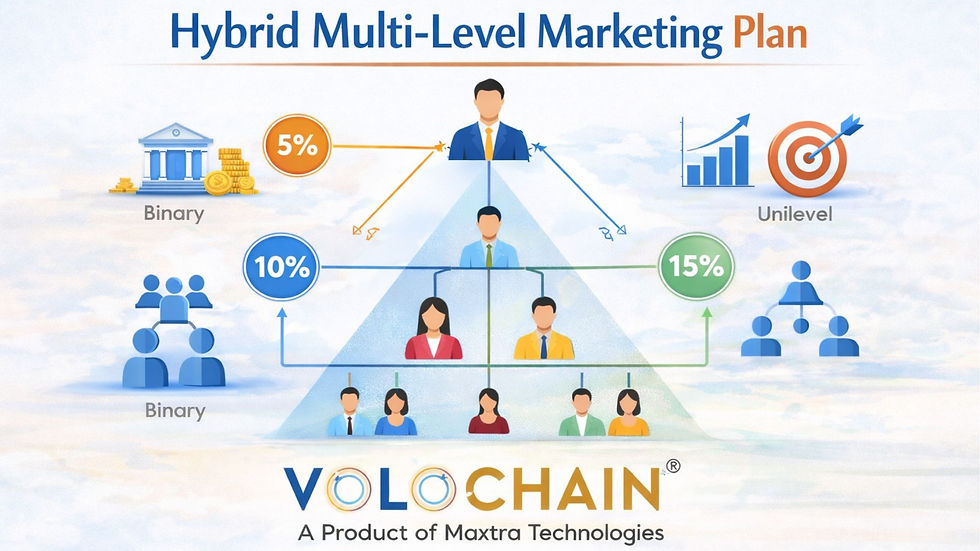
The Hybrid Multi-Level Marketing plan is regarded as one of the most innovative and flexible compensation plans in the MLM industry. Many individuals are not aware that this plan is actually a combination of two traditional MLM plans. In the past, the hybrid MLM idea was first introduced in the 1980s and has continued to develop as a viable alternative for network marketing businesses aiming for balanced growth.
Network marketing software is an essential tool in the management of hybrid MLM plans, as it enables businesses to effectively manage their complex compensation plans while enjoying the benefits of multi-level marketing. As the name implies, the hybrid plan encourages participation and involvement from all members without any limitations based on the organizational hierarchy.
Unlike the Australian or binary committee-based models, hybrid MLM plans do not depend on profit sharing decisions. There are no set positions or defined role divisions. Each participant is considered an independent distributor, and business development is mainly dependent on the popularity and performance of products rather than hierarchical authority.
What Is a Hybrid MLM Plan ?
A hybrid MLM plan is a blend of two different compensation plans. The two plans are most commonly the Binary plan and the Unilevel plan.
The Binary plan is commonly used in an MLM business setup as it enables the generation of income quickly with a two-leg structure. However, it also involves higher payment obligations and costs, making it less feasible for small to mid-scale MLM business start-ups.
To counter such drawbacks, the Unilevel plan is incorporated into the business setup. The Unilevel plan is most suitable for new MLM business start-ups as it involves a simpler setup with a direct line for distributors to recruit members.
By integrating the fast income-generating capability of the Binary plan with the cost-effectiveness of the Unilevel plan, companies are able to develop a well-rounded and scalable compensation plan called the Hybrid MLM Plan.
Hybrid MLM Plan Software and Its Usage
The Hybrid MLM software is designed in a dual-structured format. On the Binary side, the software is designed with a two-leg compensation structure, which allows the distributor to recruit only two direct distributors under them. The commission is calculated based on the total business volume and can be customized as per the business requirements.
This software also assists in identifying top-performing distributors and genuine customers, allowing businesses to target loyal customers rather than focusing on one-time customers. Compared to generation-based compensation plans, the hybrid MLM compensation plans are more organized and less complex.
The major benefits managed through hybrid MLM software include stable bonuses, start-up bonuses and sponsorship bonuses. These types of bonuses serve as a motivation tool for distributors while ensuring financial viability.
Major Bonus Schemes in Hybrid MLM Compensation Plans
1. Stable Bonus
The stable bonus is created to ensure that the distributors earn a steady income, irrespective of the market conditions. The bonus amount is determined by the network administrator and aims to promote long-term loyalty.
Though it is not a preferred choice for small startups due to financial limitations, even a small stable bonus can work wonders for the distributors. This bonus can be increased as the business expands.
2. Start-Up Bonus
The start-up bonus is also known as the joining bonus or referral bonus. It is one of the most popular bonuses in any MLM business. The bonus is earned by sponsors when they recruit new distributors and in some cases, the downline members also receive the bonus during the secondary level of referrals.
But it is not a good practice to offer high start-up bonuses, as it may create financial burdens. The bonus amount should be in sync with the overall business volume and objectives.
3. Sponsorship Commission
Sponsorship commissions are compensation systems that reward sponsors for developing and maintaining their teams. Sponsors earn money from distributor registrations, distributors earn money from team performance, and members earn money mainly from product sales.
The Hybrid MLM software combines the Unilevel structure to ensure that the sales of employees are recorded separately. This helps in the accurate distribution of commissions based on data analysis.
Conclusion
The Hybrid MLM plan is not similar to the stair-step or single-structure MLM business plans. Like any other compensation plan, it has its own strengths and weaknesses. Starting a successful MLM business requires proper planning, quality products and an effective compensation plan.
Products that satisfy the day-to-day or basic needs of consumers are likely to scale faster in the network marketing industry. By tailoring a hybrid MLM plan according to business objectives, organizations can easily attain growth and distributor satisfaction.
To attain the best outcome, it is always advisable to take professional advice from experts in the industry with successful experience in MLM software development. Solutions such as Volochain MLM Software have hybrid MLM plans that are customizable to facilitate scalable and long-term success in network marketing.


Comments